Solar-Powered Irrigation in Kenya: How Small Farms Can Harness Renewable Energy for Year-Round Vegetable Production
For farmers considering farming with solar in Kenya, the ideal system should be designed around the farm’s water source, pumping distance, elevation, crop water requirements and available sunlight rather than simply choosing the largest solar panel. Combining solar pumping with water storage tanks and drip irrigation can improve reliability by allowing water to be pumped during sunny periods and used when crops need it. Before installation, farmers should assess the borehole or river flow rate, required pumping head, daily water demand and irrigation area with a qualified solar and irrigation technician. With the right design, solar-powered irrigation can reduce dependence on fuel and unreliable electricity while supporting more consistent vegetable production during Kenya’s dry seasons.
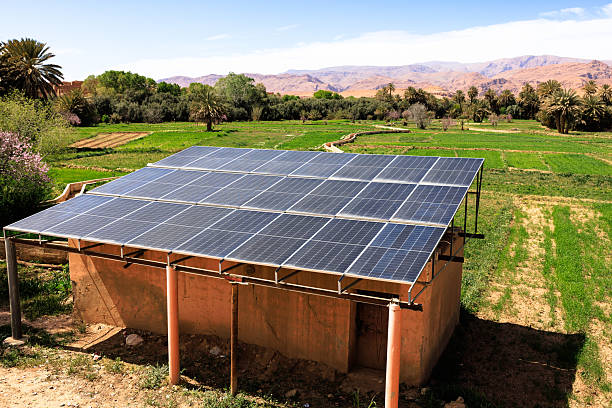
Solar panels powering a building in a lush oasis, promoting sustainable practices in Tinghir, Morocco
The transition to green renewable energy in Africa and around the word has seen a significant shift in demand for renewable energy. Solar panels have become an integral component in the planning of energy supply in farms in rural Kenya. For small farms focused on subsistence or commercial agriculture the need to secure solar pals to supply energy for small scale irrigation of crops like kales and cabbages is essential.
For a small 1 acre farm with a river or borehole or perhaps a well nearby, a solar powered generator can be efficiently used to pump water for irrigation purposes to irrigated the vegetables in the hot dry seasons. For drip irrigation, Solar panels about 600 – 1200 Watts would be ideal combined with solar water pump , pump controller and water storage tanks and finally the irrigation drip lines for a proper set up.
A solar pumping kit with 15 m is ideally capable of irrigating half acre field vegetables depending on the contextually conditions for example the specific terrain of the field in question. Another technical reference with a larger capacity of 1.5 Horsepower plus three 400 watts panel would also suffice the needs to irrigate the ½ acre field under certain conditions with careful regards to the exact water depth and flow requirements that matter when deciding on the ideal functional and rather effective set up requirements.
For farmers considering this approach, the ideal system should be designed around the farm’s water source, pumping distance, elevation, crop water requirements and available sunlight rather than simply choosing the largest solar panel. Combining solar pumping with water storage tanks and drip irrigation can improve reliability by allowing water to be pumped during sunny periods and used when crops need it. Before installation, farmers should assess the borehole or river flow rate, required pumping head, daily water demand and irrigation area with a qualified solar and irrigation technician. With the right design, solar-powered irrigation can reduce dependence on fuel and unreliable electricity while supporting more consistent vegetable production during Kenya’s dry seasons.