A SHORT HISTORY OF KENYA
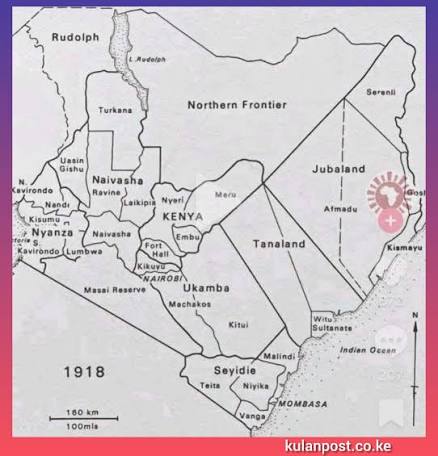
The earliest inhabitants of Kenya were hunter-gatherers but from about 2,000 BC herders came to the region. Then from about 800 AD Arabs sailed to Kenya. Some settled and intermarried and they created the Swahili culture along the coast.
The first European to reach Kenya was Vasca da Gama in 1498. Subsequently the Portuguese dominated the coast of Kenya for 2 centuries. However they did not penetrate inland. Still the Portuguese brought new crops to Kenya, maize and cassava.
Then in the late 19th century Kenya came under British control. In 1883 Joseph Thomson was sent to map Kenya. Then in 1885 the European powers divided up Africa between themselves at the Berlin Conference and Britain was allocated Kenya.
At first Kenya was administered by the Imperial British East Africa Company, which was formed in 1887. However in 1895 the British government took responsibility for Kenya. Then in the years 1895-1901 the British built a railway across the region. In the early 20th century while settlers flocked into Kenya taking the best land and the natives were forced onto reservations. Indians also came to Kenya and formed a middle class or traders.
Naturally the Africans resented their treatment and in 1921 they formed the East African Association to fight for their rights. In 1924 it changed its name to the Kikuyu Central Association. In 1927 Jomo Kenyatta became its Secretary. Meanwhile schools were founded in Kenya and the Africans became better educated. Many of them fought in the Second World War but afterwards they were treated as second-class citizens again. Their resentment eventually boiled over into the Mau Mau uprising in Kenya.
The Mau Mau formed in 1952. They took secret oaths to kill Europeans and African collaborators. In 1952 a state of emergency was declared in Kenya. British troops were sent to deal with the insurgency. Then in 1953 the British began detaining Kikuyu in concentration camps. Slowly the British hunted down the insurgents and by the end of 1956 the uprising was over.
Nevertheless the movement towards African independence was unstoppable. In 1961 an African political party Kenya African National Union was formed and in May 1963 KANU won a majority of seats in the Kenyan assembly. Finally Kenya became independent on 12 December 1963. In 1964 Jomo Kenyatta became president of Kenya and Kenya joined the Commonwealth.
Modern Kenya
The late 1960s and 1970s were years of prosperity for Kenya and agriculture developed rapidly. However Kenyatta died in 1978 and Daniel arap Moi then became leader of Kenya. In 1982 he banned opposition political parties and in 1987 he changed the constitution of Kenya to strengthen his powers. However in the 1990s Moi faced growing opposition.
In 1991 Moi was forced to allow other political parties to form in Kenya. Despite the opposition he was re-elected in 1992 and in 1997. Then in 1998 a bomb exploded in the US embassy in Nairobi. The explosion killed 224 people and for a short time it had a devastating effect on tourism in Kenya. However the tourists soon returned.
Then in 2002 Mwai Kibaki became leader of Kenya and in 2003 he introduced free primary education. However in 2009 northern Kenya suffered a drought. However today the economy of Kenya is growing rapidly. Kenya is developing fast and there is every reason to be optimistic about its future. Meanwhile in 2013 Uhuru Kenyatta became president of Kenya. Today the population of Kenya is 46 million.
Early Humans in Kenya:
Fossils found in East Africa suggest that protohumans roamed the area more than 20 million years ago. Recent finds near Kenya’s Lake Turkana indicate that hominids lived in the area 2.6 million years ago.
Pre-Colonial Settlement in Kenya:
Cushitic-speaking people from northern Africa moved into the area that is now Kenya beginning around 2000 BC. Arab traders began frequenting the Kenya coast around the first century AD.
Kenya’s proximity to the Arabian Peninsula invited colonization, and Arab and Persian settlements sprouted along the coast by the eighth century. During the first millennium AD, Nilotic and Bantu peoples moved into the region, and the latter now comprises three-quarters of Kenya’s population.
The Europeans Arrive:
The Swahili language, a mixture of Bantu and Arabic, developed as a lingua franca for trade between the different peoples. Arab dominance on the coast was eclipsed by the arrival in 1498 of the Portuguese, who gave way in turn to Islamic control under the Imam of Oman in the 1600s. The United Kingdom established its influence in the 19th century.
Colonial Era Kenya:
The colonial history of Kenya dates from the Berlin Conference of 1885, when the European powers first partitioned East Africa into spheres of influence. In 1895, the U.K. Government established the East African Protectorate and, soon after, opened the fertile highlands to white settlers.
The settlers were allowed a voice in government even before it was officially made a U.K. colony in 1920, but Africans were prohibited from direct political participation until 1944.
Resistance to Colonialism – the Mau Mau:
From October 1952 to December 1959, Kenya was under a state of emergency arising from the “Mau Mau” rebellion against British colonial rule.
During this period, African participation in the political process increased rapidly.
Kenya Achieves Independence:
The first direct elections for Africans to the Legislative Council took place in 1957. Kenya became independent on December 12, 1963, and the next year joined the Commonwealth. Jomo Kenyatta, a member of the large Kikuyu ethnic group and head of the Kenya African National Union (KANU), became Kenya’s first President. The minority party, Kenya African Democratic Union (KADU), representing a coalition of small ethnic groups, dissolved itself voluntarily in 1964 and joined KANU.
The Road to Kenyatta’s One-Party State:
A small but significant leftist opposition party, the Kenya People’s Union (KPU), was formed in 1966, led by Jaramogi Oginga Odinga, a former Vice President and Luo elder. The KPU was banned shortly after and its leader detained. No new opposition parties were formed after 1969, and KANU became the sole political party. At Kenyatta’s death in August 1978, Vice President Daniel arap Moi became President.
A New Democracy in Kenya?:
In June 1982, the National Assembly amended the constitution, making Kenya officially a one-party state, and parliamentary elections were held in September 1983.
The 1988 elections reinforced the one-party system. However, in December 1991, Parliament repealed the one-party section of the constitution. By early 1992, several new parties had formed, and multiparty elections were held in December 1992. Because of divisions in the opposition, however, Moi was reelected for another 5-year term, and his KANU party retained a majority of the legislature. Parliamentary reforms in November 1997 expanded political rights, and the number of political parties grew rapidly. Again because of a divided opposition, Moi won re-election as President in the December 1997 elections. KANU won 113 out of 222 parliamentary seats, but, because of defections, had to depend on the support of minor parties to forge a working majority.
In October 2002, a coalition of opposition parties joined forces with a faction which broke away from KANU to form the National Rainbow Coalition (NARC).
In December 2002, the NARC candidate, Mwai Kibaki, was elected the country’s third President. President Kibaki received 62% of the vote, and NARC also won 59% of the parliamentary seats (130 out of 222).
(Text from Public Domain material, US Department of State Background Notes.)
Bantus in Kenya – North, East Coast Bantu
They include those who live near the coast and in the plains: Pokomo, Taita, Makonde, Taveta and the ‘nine tribes’ of the mijikenda(Digo, Chonyi, Kambe, Duruma, Kauma, Ribe, Jibana and Giriama).
Bantus in Kenya – Highland Bantu
They live in the central highlands near Mt Kenya and the Nyandarua (Aberdares) Range: Chuka, Aembu, Mbeere, Kamba, Agikuyu and Ameru.
Bantus in Kenya – Inter-clusterine Bantu
They live in and on the lake Victoria basin in the west: Abagusii, Guba, Kuria and Abaluhya.
Although each of the communities shares the root language, their own languages, dialects and variations are not necessarily mutually intelligible.
The Agikuyu are the largest single group in Kenya. The Luhya are the second largest Bantu speakers. ‘Luhya’ refers to both the people and the languages, and the group has 16 sub-tribes. The dominant are the Maragoli, Abanyore, Isukha, Abakhayo and Abanyala in Busia and Kakamega, and Bukusu in Bungoma. Others are Abamarachi, Abatsotso, Abasamia, tiriki, Wanga, Marama, Idakho, Kisa and Abatachoni.
The luhya are farmers who grow cassava, tea, maize, wheat, rice and sugarcane. The Bukusu and the Wanga are mainly cash crop farmers and the Saamia fishermen and traders.
The linguistic groupings form the rich cultural diversity that is the basis of Kenya’s development, social cohesion and peace.
The diversity is a national driving force lingustically, economically and politically. Groups share many similarities and differences within and among themselves.
Reasons for the Migration of the Bantus from their Original Homeland to Kenya
- Growing population and need for more space.
- The need for more land for cultivation.
- Search for additional pastures.
- Internal quarrels arising especially from population pressure.
- Attacks from neighbobouring communities
- Prevalence of diseases
- The spirit of adventure
The British Colonisation Of Kenya History Essay
Published: 23rd March, 2015 Last Edited: 23rd March, 2015
This essay has been submitted by a student. This is not an example of the work written by our professional essay writers.
The aim of this coursework is to examine and critically assess, to what extent the British colonisation of Kenya have a positive impact on Kenyan history. As with much historical interpretation, the impact of British colonisation on Kenya is subject to much debate. For many historians, colonialism has had a powerful and lasting impact on Africa. For instance, Crawford Young believes the ”overall colonial legacy cast its shadows over the emergent African state system to a degree unique among the major world regions.”[1] This means that Africa can neither be explained nor understood without first unravelling the continent’s colonial experience. Some historians like Adu Boahen preferred to adopt a middle course and state that ”[2] in some respects the impact of colonialism was deep and was certainly destined to affect the future course events, but in others, it was not.” [3] Moreover, Peter O Ndege elaborated in his lecture that Kenyan ‘communities were highly acephalous and segmented’. Sherriff supports Ndege and additionally connotes that the communities in Kenya ‘for many centuries adjusted themselves to their ecological niches.'[4] This underpins the divisions present within communities inside of Kenya such as the ‘Agikuyu who adapted within the highlands developed their own agricultural economies, whereas others including the Maasai and the Samburu from the dry and semi-arid areas practised pastoralist forms of production.'[5] Kenya is populated with different ethnic groups including the Nilotes, Bantu, Cushites and Semites each allocated in their ancestral land, where they had their own beliefs, traditional government, medicine men/ herbalist and taught their children to grow up to serve as a loyal member in each of their communities. In 1885 after the Berlin Conference, British declared Uganda and Kenya as their ‘protectorates’ respectively, the Kenyan community ‘traditional’ social, political and economic structure was transformed and by the 1920s pre-colonial Kenya was a different society. Colonialists would argue they ‘blessed’ Kenya by ‘modernising’ it by giving it a boundary, a government, improved infrastructure, agriculture and industrialisation. Furthermore, it could be argued ‘that British colonisation united what was essentially a divided land, industrialised and modernised an agrarian people.’ [6] However, Kenyan history refutes such assertions and instead this history reveals that many of the problems which occurred within the state by 1980s contradicted the positive ‘blessed’ impact in Kenya. Rather, the problems Kenya experienced in the 1980s ‘serve to merely reinforce the view that British colonisation, created an artificial territory and arbitrarily brought together over forty previously independent communities into one territorial entity’.[7] Kenya was a man-made nation, fraught with the problems inherent to British colonialism and imperialism within Africa. Therefore, throughout this essay I am going to evaluate to what extent British colonisation in Kenya had a positive impact.
During, pre-colonial Kenya, the country was mainly ‘a rural nation except for a bit of urbanization on the coast mainly from Arab traders'[8]. The ethnic groups that are now seen as urbanite in Kenya were living in rural communities raising their cattle and goats and a bit of cultivation. Conjointly, Kenya’s history of ‘inter-ethnic interactions were characterized by trade, intermarriages, limited and intermittent warfare.’ [9] This means that there was less interaction between the communities was done during that era apart from trade (which at the time was exchanging of goods. Moreover, Pre-colonial Kenya’s economic, social and political situation can only be explained collectively as well as separately according to each language group because of the varied culture adaptations. The tribes in Kenya according to Arjen Koopman, like elsewhere in East Africa before 1885 were divided into three language groups being the Bantus, Nilotes and Cushites.[10] The Cushitic speaking peoples who included mainly the Somali, Boni, Redille and Wata, moved into Kenya from North African territory in 2000 BC and adapted to be hunterer-gatherers, but also livestock herders and farmers. Whereas the Bantu and Nilotic peoples, moved from West-Africa and included mainly the Kikuyu, Mijikenda, Dawida, Taveta, Akamba as the Bantus and Masai, Luo, Kalenjin, Turkana as the Nilotes.. Furthermore the Bantus pre-colonially practised new technologies such as iron working and also practised farming supplemented with herding, fishing, hunting, gathering and trading their iron products whilst other tribes mainly limited themselves to hunting and gathering.
According to Walter Rodney, ‘every people have developed in one way or another and to a greater or lesser extent.’ This means that he supports the fact that pre-colonial Kenya was efficient with itself in no need for any form of aid in order to develop it therefore in this case the British colonialist’s liability to build Kenya was unnecessary.[11]
The Anglo-German, Berlin confernce the company changed its name and was given the royal charter as Imperial British East Africa Company. At the same time that the British Government started talks in 1890 with the Germans to clarif the boundaries. In the agreement signed after the talks, Germany recognised Uganda as part of the British are of influence accepted a British protectorate over Zanzibar and Pemba. The Imperialists used Kenya’s coast to connect to Asia, Uganda was reffered to the fertile land at the time as they underestimated Kenya. Kenya was then used as a gateway to Asia, it was for this reason the Kenya-Uganda railway was built. The tract land between the coast and the protectorate of Uganda was a wasteland for the British Government but it needed some legal protection and some administration to ensure easy transport to Uganda.
On 1st July 1985 the are from the coast strip ti the Rift valley was declared tthe British East Africa Protectorate. The imperial British East Africa Company had the burden of keeping the route open. For this they had to have managed forts along the route. Each of these would require some 2,000 manloads a year. It is no wonder that Mackinnon advocated from the very begining the construction of a railway. He surveyed the land and built a small track in Mombasa to entice business and government officials to back his project.
Within the context of 1885-1985, to what extent did the British colonisation of Kenya have a positive impact
Accordind to Ndege there is a direct link between Colonialism developed from imperialism and Capitalism. Ndege denotes that ‘Capitalism, imperialism and colonialism share the definitions of poitical , cultural and economic exploitation.’ This a main reason as to why the Berlin Conferece was held in 1884 .It was at this point that thelaunching of Kenya ass part of a British imperialist wealth commenced in 1885 during The Berlin Conference where an Anglo-German convention was held according to Ndege to ‘set the rules which would determine the inter-European boundary arrangements.’ The Berlin conference played the role in favour of the European, constructing borders around Africa giving ‘super power states’ the imperial authority and ownership of the territories marked in an African map that would support in the growth of their countries. Moreover an argument in favour of the conference would state that it would have been the spread of infrastructure and growth of industrial development within Africa. Moreover it would also unite the language groups existing into one collective nation, where they would be a ‘civilised’ working union under colonial rule. Ndege disagrees and states that it was an agreement that made Kenya a man-made nation and created boundaries that were demarcated without the consultation of Kenyan people. Furthermore, he argues that the colonial boundaries caused territorial entity and the pre-colonial state would find it an overwhelming task to understand they are in a country. Ndege gives an example of the Plains Nilotes such as the Masai, who took the entire colonial period to understand the perception of the colonial administration. A case study that ratifies post-colonial Kenya in this territorial creation, is observed during the reign of Jommo Kenyatta whereby according to….Kenyatta immediately swerved from radical nationalism to conservative bourgeoisie where he gave plantations formerly owned by white settlers to the favoured recipients being the Kikuyu farmers, along with their allies the Embu and Meru in a result of grabbing the country’s wealth and power in the hands of an organisation (Gikuyu-Embu-Meru Associaton,GEMA ) which grouped these three tribes comprising according to statics to be only 30% of the country’s population. In addition, the Kikuyu , with Kenyatta support spread beyond their territorial homelands and repossessed lands ‘stolen by the whites’ even when they had previously belong to other groups leaving an outraged 70% majority and setting up long term ethnic animosities. Jommo Kenyatta’s land distribution method illustrates the lack of Unity among the Kenyans after the independence and a born cycle of inequality as well as ethnic hierarchy introduced by the outcomes of boundary set up which questions the positivity of colonial infrastructure development.
More seriously the boundaries were responsible for divinding single communities such as the Masai and Kuria, Somalia and Ethiopia, the Luo, also among Kenya,Uganda and Tanzania, and the Teso and Samia between Kenya and Uganda. The fact that the administrative and ethnic boundaries were conterminous nurtured negative ethnicity competition as different communities competed for colonial resources.
Inter-ethnic competition would characterize the post 1945 nationalist struggles and post colonial politics. Examples include attempts by the Kalenjin and coastal communities to establish quasi-federalism as a counterpoise to Kikuyu-Luo domination in independent Kenya. Furthermore, the colonial boundaries would also lead to Somali, secessionist attempts by the Kenya Somali in their bid to join their kith and kin in neighbouring Somali. The colonial state employed authoritarian force to hold Kenya’s diverse communities together
Within the context of 1885-1985, to what extent did the British colonisation of Kenya have a positive impact?
British colonisation came with motives of making Kenya a means of transport in order to develop the country’s communication as well shorten the distances. During colonial Kenya, a Kenya-Uganda railway was established. The railway was built in order to metre a measure the distance in the country and according to Victoria it was also ‘a source of locomotive and rolling stock’. Moreover it was a key construction that was supposed develop Kenya’s interior by linking Kenya and Ugandan protectorates. It was at this era where 32,000 workers were imported from India to do the manual work. Consequently Victoria states that the railway encouraged labour, whereby whether skilled or unskilled, workers were imported in from India, many of whom remained after their contracts ended to become the nucleus of the Asian community in Kenya. This shows an emergence of a new alien culture migration to Kenya which would have increased ethnic diversity post colonisation. Moreover, rapid economic development was essential and seen as necessary to make the railway pay because African population was accustomed to subsistence rather than exported agriculture and was argued by colonialists to be uncouth for economical development. The colonial government therefore encouraged the European settlement in the fertile Highlands, which had been understood to have small
The question of substantiability of railway became the preoccupation of Sir Charkes Elliot, the British High Commision who thought Africans wouldnt be able to produce enough goods to sustain operation of the line, so he encouraged white settlers whom he believed should be the ones to control the trade along the railway line. As result of white settlers being introduced by the colonial government according to….a number of problems fell under Kenyans as the white. settler ‘squattering’ was a massive land alienation from Africans as they were pushed to reserves which meant they would be room for racial segregation and forced labour in the European plantations put upon the Kenyans. A good example of a successful white settlement that continued past colonialism question Africans on whose land it was, in Wangari Mathai’s chapter on landowner ship, she addresses a good example of post colonial white settlement being that of the case of Lord Delamere of Britain who
was a major figure in the first three decades of British Rule in Kenya and controlled land purcheased from the Maasai for pittance, that extended over hundreds of thousands of acres in the Central Highlands and the Rift Vallley (being the largest province in Kenya). Moreover she states that, the same Delamere family remain after independence and among Kenya’s largest landholders holding 48,000 acre wildlife conservancy which affects the Kenya income as its main foreign exchange towards the 1980s was Wildlife Tourism. Wangari proceeds by stating Since independence, the descendent of Lord Delamere have remained close to members of political elite, althought with Nijoya’s murder, the case has fascinated Kenyans and Europeans alike, as it encapsulates the racial class and landownership. According to Wangari Mathai, the Delamere family believe that the land and animals on it are their right-fully theirs, and tresspassers on their property, whether those chasing poachers or poaching themselves, risk being shot. While the Delamares own beef and dairy operations
who shot to death a Kenya Wildlife service game warden investigating suspected poaching and property.
Alienation of land displacement of Africans from their ancestoral land if the basis of post colonial conflicts experienced in Rift Valley and Coast Provinces. This is part of historical injustice that the country tries to address even in the post-colonial era.
Railway in Kenya
One of the most significant colonial developments that took place in Kenya is the construction of the Kenya Uganda railway which started in 1895, running from the East Coast to Kisumu the West. It was completed by 1901. The British government had decided, primarily for strategic reasons, to build a railway linking Mombasa with the British protectorate of Uganda. A major feat of engineering, the “Uganda railway” (that is the railway inside Kenya leading to Uganda) was completed in 1903 and was a decisive event in modernizing the area. As governor of Kenya, Sir Percy Girourd was instrumental in initiating railway extension policy that led to construction of the Nairobi-Thika and Konza-Magadi railways.
Some 32,000 workers were imported from The British India to do the manual labour. Many stay, as did most of the Indian traders and small businessmen who saw opportunity in the opening of the interior of Kenya. Rapid economic development was seen unnecessary to make the railway pay, and since the African population was accustomed to subsistence rather than export agriculture, the government decided to encourage interior, not only to the European farmers, missionaries, and administrators, but also to systematic government programs to attack slavery, witchcraft, disease and famine. The Africans saw witchcraft as a powerful influence on their luives and frequently took violent action against suspected witches. To control this aggression
Within the context of 1885-1985, to what extent did the British colonisation of Kenya have a positive impact?
Colonial military expeditions led to genocide and forced migrations of people among the Agikuyu, Abagusii, The Nandi, Giriama and all the others who met colonial force. Colonial conquest led to loss of sovereignty as colonial rulers replaced indigenous leaders. This was one of the ironies of British indirect rule. Based on empty platitude, British indirect rule often led to recruitment of British collaborative agents and porters into leadership positions. Colonial military expeditions led to genocide and forced migrations of people. Moreover British colonial administration reflected orders from Britain rather than the consensus of community leaders. Colonial governance through Chiefs’s councils, native tribunals and local native councils was therefore a mockery of democracy. Chaired by colonial district officers these institutions acted as a legal and administrative devises that were intended to keep Africans in their subordinate place. The purpose they served included political expedience and imposition of administrative costs on Africans. Law and order was, therefore, maintained in the interest of British capitalist accumulation.
Read from Kenyan Gulag and then you will be able to elaborate on the point that there were Kenyans who were used as puppets in order to have indirect rule. Look for examples of puppets. And then look for a balance course in favour of that issue. Moreover this is innerline of a major topic. Could this really on the post-colonialism. This does have a negative impact because people being told to work are assimilated to Western Cultrure and are the Betrayers.
On a broader scale colonial plans developed in London. The Europeans dominated executive and legislative councils formulated policies and made budgets in Nairobi with approval of London.
Africans were excluded from these councils, which were chaired by the Governor until and after the Second World War. Indeed, even European settlers complained that the councils were dominated by government officials. British indirect rule kept governance at a distance from people. The colonial state centralised, radicalised and ethnised power. This administrative set up, save its racial trappings, was wholly inherited by the post-independence regime.
In a fundamental sense post-colonial governance became even more autocratic. Unlike the governor who was accountable to the House of Commons, Kenya’s post colonial presidents have hardly been accountable to Parliament. Constitutional reforms since independence has transformed Kenya into a patrimonial and autocratic presidential system. Thus independent Kenya inherited and worsened the colonial crisis of governance with dire human rights and economic consequences
This relates to the idea that a legacy has been achieved because of the reformed African government; however the rulers are unjust and autocratic and cannot be put on trial…
Look for cases that would proof this. The reign of president Arap Moi is a good example of autocratic president who killed silenced those who raised an issue. And then look into the 1980 coup and see how you are able to relate to the inequalities of landownership and dictatorial rule. A political rupture which was a result of a dominant tribe taking over the leadership.
Sir Fredrick G Lugard, the high priest and agent of British imperialism in East and West Africa once made the following statement: ” European brains, capital and energy have not been, and never will be expended in developing the resources of Africa from motibes of pure philanthropy” (quoted Chiryankandath, 2007: 7) Lugard had no doubts regarding the motives of British colonialism: economic benefits for British metropolitan and local investors. In Kenya they included a number of mechant houses and thousands of European settlers (Swainson, 1980; Ochieng and Maxon, 2000). Like other proponents of British colonialism Lugard did not really care if Africans in Kenya reaped incidental benefits at the behest of the Keynesian economics of imperialism.
At any rate, British colonial economic policy in Kenya included the following: Land alienation for European settlers (Sorrenson, 1968). African taxation (Tarus, 2004), African migrant/ forced labour (Zeleza, 1992) development of settler dominated agricultural production and peasant commodity production, export production, rail and road transport and communication, education and health.
Case study
Railway in Kenya
One of the most significant colonial developments that took place in Kenya is the construction of the Kenya Uganda railway which started in 1895, running from the East Coast to Kisumu the West. It was completed by 1901. The British government had decided, primarily for strategic reasons, to build a railway linking Mombasa with the British protectorate of Uganda. A major feat of engineering, the “Uganda railway” (that is the railway inside Kenya leading to Uganda) was completed in 1903 and was a decisive event in modernizing the area. As governor of Kenya, Sir Percy Girourd was instrumental in initiating railway extension policy that led to construction of the Nairobi-Thika and Konza-Magadi railways.
Some 32,000 workers were imported from The British India to do the manual labour. Many stay, as did most of the Indian traders and small businessmen who saw opportunity in the opening of the interior of Kenya. Rapid economic development was seen unnecessary to make the railway pay, and since the African population was accustomed to subsistence rather than export agriculture, the government decided to encourage interior, not only to the European farmers, missionaries, and administrators, but also to systematic government programs to attack slavery, witchcraft, disease and famine. The Africans saw witchcraft as a powerful influence on their luives and frequently took violent action against suspected witches. To control this aggression
These policies were formulated and implemented incrementally during specific stages of colonialism: the pre-1920 period which was interrupted by the outbreak of the First World War; the interwar period which also saw the great depression between 1929 and 1934; the Second World War 1939-45 and the post-War era ( Wiggley, 1965). The implementation of these policies was characterized by a series of contradictions with which the colonial state had to cope, rarely with any success (Londsdale and Berman, 1979). There was, for instance a clash of interests between metropolitan capitalists and the colonial state in Kenya. British merchants and financiers often won the day. Internally African, Indian and European settlers had the ear of pro-settler governors. Morover, in the interest of capital these policies were anchored on partial dissolution and restructuring of pre-colonial structures. It was often cheaper, even if not efficient, to use pre-capitlist forces and relations of productions. It was also in the interest of capital to replace the market under the colonial’s state control. This was done with greater enthusiasm during the Second World War more popularly known as the second colonial occupation. Colonial commodity production, because of inappropriate practice, led to widespread environmental degradation. Forest concessions which were granted to individuals and companies led to massive deforestation. Colonial enterprises destroyed local industries. Generally the economic policies in Kenya were instrumental in incorporating the pre capitalist communities into the colonial and international economic systems. This persisted into the post-colonial period.
Similarly, Christian missionaries activities destroyed African culture through the gospels of salvation, obedience and work. Through Western education, which they had dominated despite the colonial state’s role, Christian missions preached against African cultures. They were emphatic that the African’ salvation must be gauged on to the extent to which traditional cultural practices were abandoned. Their invocations about obeying the government because it is God who placed it there was meant to make Africans obey the colonial regime. Euro-Christian capitalist work ethic inculcated individualism and acquisitive culture. Colonial education therefore fostered the emergence of clerks and chiefs. But some of them like Johane Owalo, Harry Thuku, Jomo Kenyatta, Dedan Kimathi, Oginga Odinga and Tom Mboya. This nationalism had its basis in primordial ethnicity and colonial administration. It was only after the establishment of the Kenya African Union that the Nationalists attempted territory- wide mobilization of Kenyans. The colonial state carefully chose the leaders of the independent regime as it laid the grounds for neo-colonialism. As elaborated below the colonial economy and education established the structures and provided the historical forces that fundamentally influenced Kenya’s colonial and post-colonial society.
The colonial economy has had a lasting impact in the following ways. First, both the colonial and the post-colonial economies were characterized by two major forms of disarticulation: geographical and structural (Ake, 1980). The first refers to enclave development, which is concentration of development activities in a few urban areas: Nairobi, Mombasa, Nakuru, Kisumu, Eldoret and Naivasha. Structural disarticulation refers to the development of a limited range of activities. In Kenya these activities are largely cented on agricultural and a very limited range of Secondary industries.
Secondly , Kenya’s economy had a narrow base. It is not adequately diversed. It relies on a few primary commodities including coffee, tea, pyrethrum and flowers for foreign exchange.
According to Wangari Mathai ‘the old culture of underdevelopment, corruption, and modes of inadequate leadership remained a challenge. How much so was brought home by the plight of small scale coffee growers in my constituency . Shortly after the end of the Vietnam War, the Vietnamese government sent emissaries to Kenya to study how to expand its coffee industry. Kneya, in addition to having some of the best coffee in the world, conducts research in developing high-yield and disease-resistant varietiesof coffee. The Vietnamese not only bought different strains of Kenyan coffee, but they invited some Kenyan coffee experts to Vietnam.
‘because coffee is a commodity =, it is subject to speculatuion on the international markets, and thus growing or selling it is a very risky business. If the market for the product collapses, whether due to political instability or overproduction, farmers can end up with nothing. On a large scale the whole country suffers; on a local level entire communities and families go hungry because the farmers are growing either crops to feed people and animalsn in other countries or commodities such as coffee.’
As a consequence Kenya’s economy lacked the desire auto-dynamism. This is primarily due also to the economy’s external linkage, which places it at the mercy of fluctuations of world prices.
The third economical heritage includes the monopolistic and imperfect nature of the market. Despite the country’s pursuit of structural adjustment programs since the 1980’s Kenyan state continues to exercise control over the market through price regulation (Maxon and Ndege, 1995 and Chinsinga, 2004). As happened during the colonial era the market contuinues to serve as an instrument of political control and exploitation.
Furthermore, Kenya’s economy continued to be technologically, financially, commercially and monetarily dependent on Britain, other European countries, the United States of America and Japan. Since the advent of political independence Kenya has successfully diversified the range of countries on which she is dependent for foreign aid. The consequence of this has been the deterioration in the country’s balance of payments.
Moreover, income inequality and poverty have become more prevalent since independence (Ndege, 2008). Colonialism had its own share in the country’s inequality and poverty as it promoted rural-urban , reqional and class difference s in the development. As a nconsequence the contradictions that characterized colonial Kenya have been accentuated. These include contradictions in the social relations of production between the international and domestic bourgeoisie ,l between the peasantries and the nourgeoisie. And between capital and labour (Ake, 1980, Swainson, 1980 and Leys, 1996) Like nthe colonial state, the post colonial state has had to cope with there series of contradictions. The local bourgeoisie habitually resort to high level corruption to accumulate wealth and power. They also invoke racial and ethnic sentiments to stay in power (Leys, 1975 and Atieno Odhiambo, 2004). Superintending class and ethnic politics is the president and the political elites around him.